You have been counting down to this day your whole life.
The dress is hanging on the door. The henna is drying on your hands. The hall is booked, the food is sorted, the family is arriving from everywhere. On the outside, everything looks perfect.
But at night, when the house finally goes quiet and everyone has gone to sleep, something else is there with you.
Fear.
Not fear of marrying him. That part you are okay with. You love him, or you are learning to, and that is enough.
It is this other fear. The one that sits with you when you are alone. The one that makes you pick up your phone at midnight and type things into Google that you would never say out loud to anyone.
Will it hurt? Will I bleed? What if I do not bleed and he thinks something is wrong with me? What if I freeze up and do not know what to do? What if I disappoint him? What if the whole night goes terribly wrong?
You have tried to get answers. You have really tried.
You went to your mother. She smiled at you gently and said you would be fine, that it was natural, that you would figure it out. Then she moved on to talking about the food for the reception.
You asked your married friend. She laughed and said just relax. As if relaxing was something you could simply decide to do.
You searched online with your screen brightness all the way down so nobody would see. And what you found either scared you worse or had absolutely nothing to do with your life, your values, or your culture. Everything was written for a completely different kind of woman in a completely different world.
You are a Nigerian woman. You were raised to be modest and good and faithful. And you are all of those things. Nobody is questioning that.
But not one person in your life sat you down and told you what to actually expect. What is normal. What is a myth. What your body will do and why. What you are allowed to feel. What you have every right to ask for.
That silence is not your fault. And it is not fair to you.
It was not fair to your mother when it was her turn either. Or to her mother before her. For generations, Nigerian women have been walking into the most intimate night of their lives with nothing but fear and a prayer, and nobody thought to change that.
You are not broken for being afraid. You are not wrong for wanting to understand. You deserve to be prepared.
Please stop what you are doing and read every word on this page. What I am about to share with you matters.
Because I am about to share with you the simple preparation method that changed everything for me and for hundreds of Nigerian brides I have quietly walked through it with.
This is not new knowledge. It has always existed.
The grandmothers knew it. The elderly aunties who gathered together the night before a wedding knew it. There used to be quiet conversations between women, passed from one generation to the next, about how a bride should prepare herself. About gentleness. About her rights. About what to expect and how to ask for what she needed.
Somewhere along the way those conversations stopped. Somewhere modesty became silence, and silence became suffering, and the suffering got passed down quietly from one bride to the next like something inherited without anyone choosing it.
But the knowledge itself never disappeared. It was always there, sitting in our faith, in our tradition, in the wisdom of older women who understood marriage from the inside. We just stopped teaching it to our daughters.
My name is Amira Hassan and I want to tell you something important before we go any further.
I am not a doctor. I am not a gynaecologist or a certified therapist or any kind of medical professional. I want to be very clear about that. I am a Nigerian Muslim wife of seven years and a mother of two, and the only qualification I have is that I walked into my own wedding night carrying the exact same fear you are carrying right now, and I found my way through it in a way that changed everything for me.
I know this world from the inside. I know the silence. I know the shame. And I know what it costs a woman to enter that night completely on her own with no one to guide her.
My wedding was in October. I was 23 years old. He was a kind man, patient and well-raised, from a family our family had known for years. By every measure I was a lucky bride and I knew it.
But for the three weeks before my wedding night I could not sleep properly. Not really.
The fear started small, as these things do. Just a quiet question here and there. What exactly happens? Will it hurt? I had heard things over the years, the way you do growing up, whispered things and fragments of conversations I was not supposed to be listening to. A cousin who had cried through her entire first night. A neighbour whose experience had been so difficult her mother came to check on her in the morning. An auntie who admitted years later, almost as a joke, that she had not felt truly comfortable with her husband for the first two years of marriage.
I did not want that. I wanted something different for myself. But I had no idea how to get there because I had no roadmap at all.
Three days before the nikah I tried asking my mother. We were in the kitchen together, she was frying akara and I was standing nearby pretending to help. I said, very quietly, "Mama, what should I know about the wedding night?"
She kept her eyes on the pan. "Amira, you will be fine. It is natural. Just relax."
That was all she gave me. Relax.
So I went to Google instead. I will not describe everything I found there but I will say this: Western intimacy advice, written for women living completely different lives with completely different values, did nothing for me except add new layers of fear on top of the ones I already had. The language was wrong. The assumptions were wrong. None of it was written for a Nigerian Muslim bride who had never been alone with a man in her life.
I found a YouTube lecture about marriage rights that was spiritually beautiful and said nothing at all about the physical reality of the first night. I bought a small book from an Islamic bookshop in Kaduna that was printed in 1987 and spent most of its pages explaining that a wife must be available to her husband whenever he desires. I put that book in a drawer. I spent N4,200 on a herbal bridal preparation mixture that a girl in my cousin's bridal train swore by, drank it for four days, and had an upset stomach on the morning of my own wedding.
I asked my closest married friend Zainab directly. "Did it hurt? What did you actually do?" She laughed in the way that people laugh when they do not want to tell the truth. "Amira wallahi you will survive. Just make dua."
I loved Zainab. But she was not helping me.
Nobody was helping me.
And so my wedding day arrived.
It was beautiful, truly. The ceremony was everything I had imagined, the food was wonderful, the family came from everywhere. By eleven o'clock at night the last guests had finally gone and we were alone for the first time, me and this man I had spoken to mostly on the phone for six months and married that afternoon.
I was shaking inside. I kept that hidden, but inside I was shaking.
I will not tell you everything about that night. What I will tell you is that it was not the disaster I had feared, but it was also not what I had hoped for. Because neither of us knew how to begin gently. We had no words for it, no permission to slow down, no knowledge that we were even allowed to take our time. We were two good people who cared about each other, walking into something sacred without a single piece of preparation between us.
The weeks that followed were an adjustment in ways I could not explain to anyone. Physically uncomfortable in ways I did not understand. Emotionally a little distant in ways I could not name. I smiled through all of it because that is what we do. But alone with my thoughts I kept returning to the same question. Why did no one tell us?
The answer came three months later.
We travelled to Zaria to visit my husband's elderly aunt, Hajiya Rakiya. She was 74 years old, had been married for 48 years, and had quietly guided more young brides through the beginning of marriage than anyone I had ever met. She was the kind of woman whose eyes see everything without her having to ask a single question.
The younger women went to the market that afternoon. I stayed behind with a headache. Hajiya Rakiya and I sat together in her courtyard drinking zobo and not saying very much, and after a while she looked at me with that steady knowing gaze and said:
"You have the face of a bride who was not prepared."
I did not know how to respond to that.
"Your mother did not tell you anything, did she."
It was not even a question. I shook my head.
She made a soft sound, not unkind, just deeply tired of something. "None of our mothers told us either. And none of their mothers before them. We have been sending our daughters into the marriage bed with nothing but fear and a prayer for as long as anyone can remember. And it is time for it to stop."
She was quiet for a moment. Then she said the words I have never forgotten.
"My daughter. A wife has rights on that night. She has the right to gentleness. She has the right to her own comfort. She has the right to time and to her own pleasure. This is not a secret. This knowledge has always been there. We simply stopped passing it on to our daughters."
I leaned forward. "What should I have known, Hajiya? What should she have told me?"
For the next two hours she told me everything.
She told me the truth about the body, what is normal and what is myth, why many women do not bleed on their first night and what that does and does not mean. She explained the importance of physical preparation, of relaxation, of a woman's body needing gentleness and time before it is truly ready. She told me about KY gel, which she called simply the mercy that nobody tells brides about. She told me that there is no obligation to consummate on the very first night, that taking a week to simply be close, to get comfortable sharing a space, to ease into things slowly is not just permitted but is actually the wiser and more loving approach.
She told me that a husband carries obligations toward his wife, not only rights over her. That her comfort and her satisfaction are not extras or luxuries but are part of what a good marriage is built on.
"This has always been true," she said quietly. "We just stopped saying it out loud."
I drove home from Zaria a genuinely different woman.
I sat with my husband that evening and shared what Hajiya Rakiya had shared with me. We talked in a way we had not quite managed in those first three months. We started over, slowly and with real knowledge this time, with permission to be gentle with each other.
The difference was something I cannot fully put into words.
About two weeks later my husband took my hand one evening and said quietly, "Amira. You seem different lately. More at ease. I am glad."
I was glad too. More than he knew.
In the months after that visit I shared what Hajiya Rakiya had told me with three friends who were engaged or newly married. Bilkisu in Abuja. Maryam in Manchester. Hadiza in Lagos.
Bilkisu called me two weeks after her wedding. "Amira why did nobody tell us any of this before? I wish I had known six months ago."
Maryam, who had no aunties or elders nearby in Manchester and had been searching the internet for months without finding anything that felt right for her, told me it was the first time she had found guidance that actually felt like it was written for someone like her. "Everything else online is for a different kind of woman," she said. "This felt like home."
Hadiza sent me a short message. "My husband and I are okay now. We needed this."
When the fourth friend asked, and then the fifth, and I found myself recording the same long voice notes and typing the same long messages over and over again, I knew it was time to write it all down properly. In one place. In a way that would reach every bride who needed it, not just the ones lucky enough to know me personally.
These days I get more messages than I can respond to individually. Brides writing to me from Kano, Kaduna, Abuja, London, Calgary, Houston, all asking the same questions, all carrying the same fear, all having been given the same silence by the women who should have prepared them.
So I decided to put everything in one place. Hajiya Rakiya's wisdom, the traditional knowledge our grandmothers carried, the practical preparation steps, the body truths nobody talks about, the communication guide for talking to your husband, the full 7-day gentle transition plan. All of it, written down carefully and completely, in the plain warm language of an older sister who has been through it and wants better for you.
I wrote it the way I wished someone had written something for me. With full respect for your faith and your culture. Without shame and without the kind of Western assumptions that make most of what is available online completely useless for a Nigerian bride.
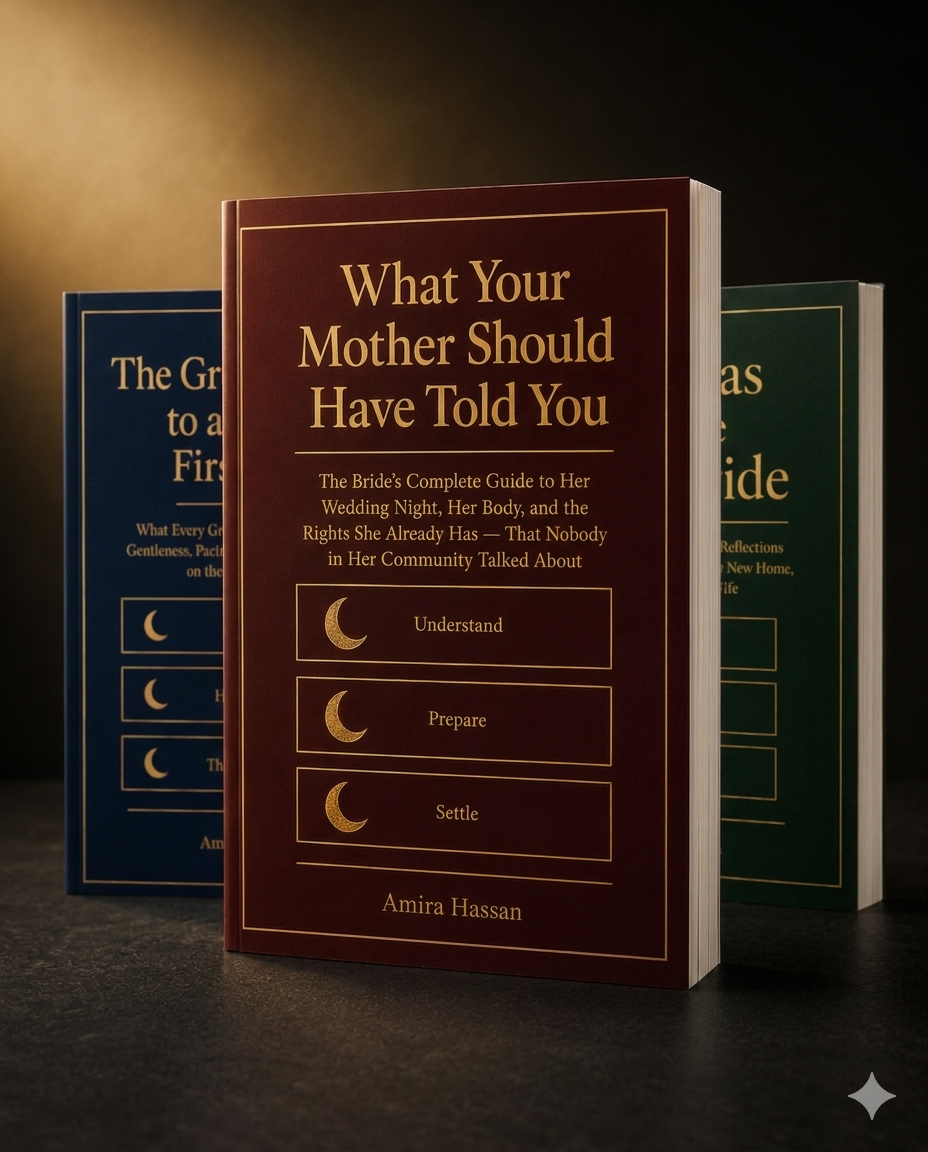
Introducing...
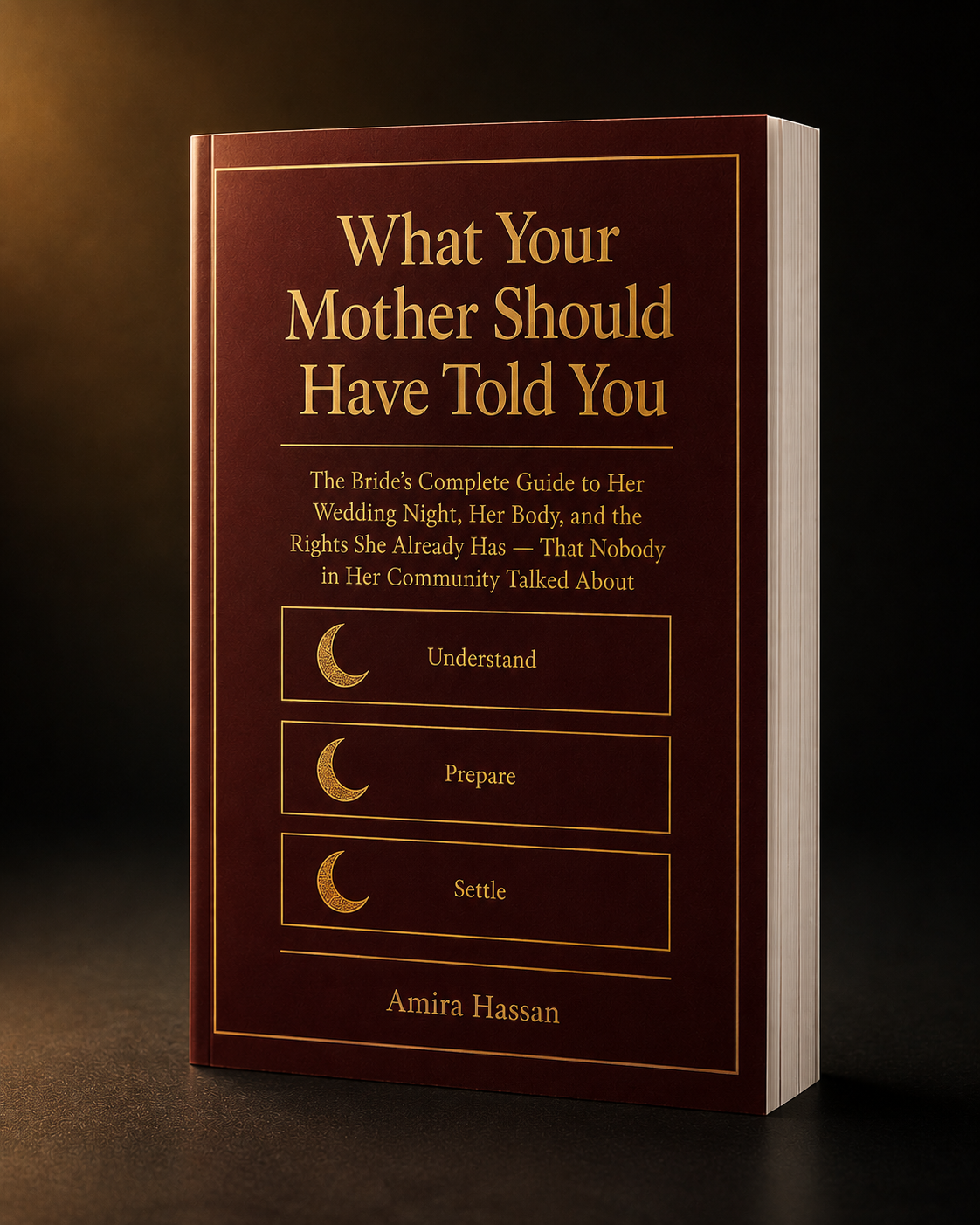
What Your Mother Should Have Told You
The Bride's Complete Guide to Her Wedding Night, Her Body, and the Rights She Already Has That Nobody in Her Community Talked About
Share Your Experience